The Reality of the Shorter GRE
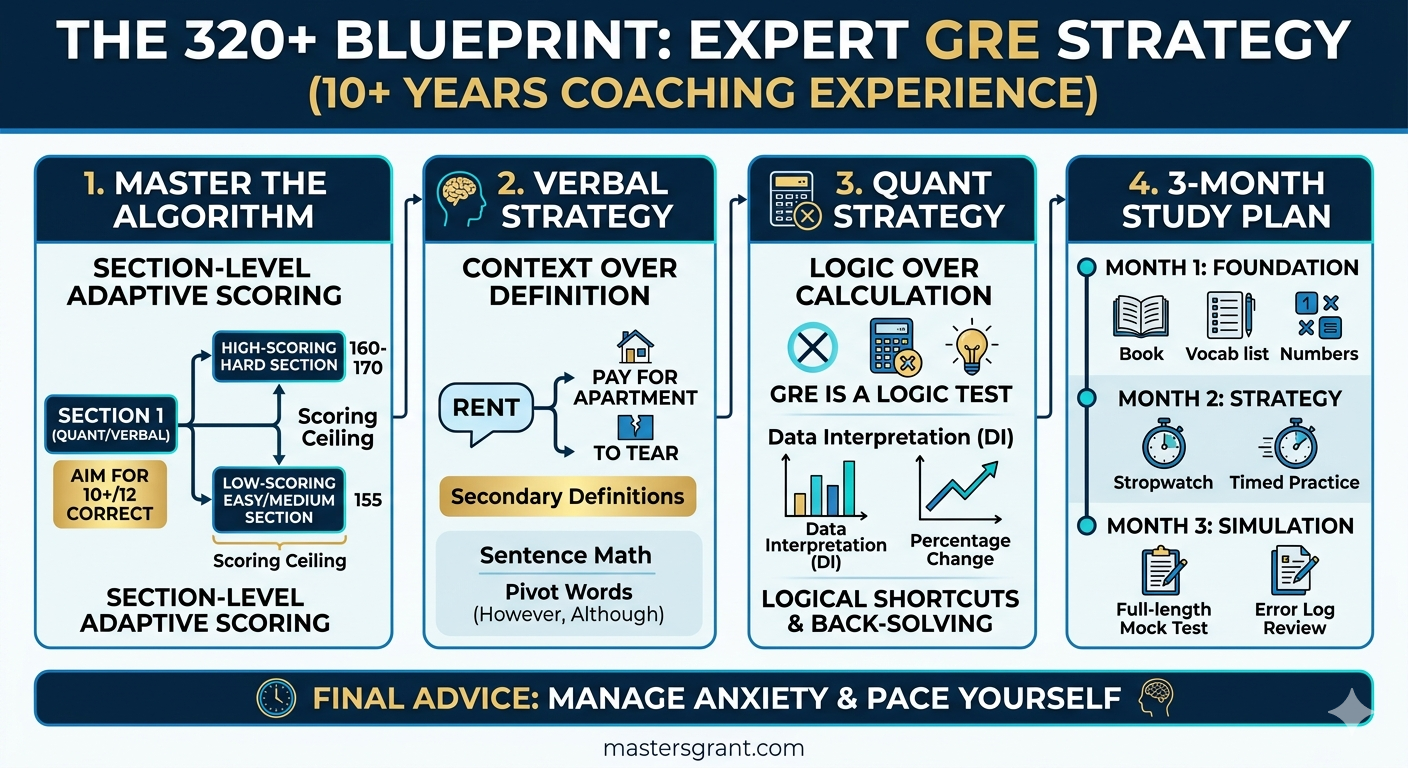
In the old days, the GRE was a marathon. Now, it’s a sprint. At 1 hour and 58 minutes, the test is faster, but the pressure is higher. With only 27 Quantitative and 27 Verbal questions in total, a single careless error can drop your score by 2-3 points. To hit 320+, you need near-perfect accuracy on the "Easy" and "Medium" questions to ensure the algorithm pushes you into the "Hard" second section.
1. The "Algorithm Hack": Mastering Section-Adaptive Scoring
The GRE is section-level adaptive.
- The First Section is Everything: Your performance on Section 1 of Math and Verbal determines the difficulty of Section 2.
- The Scoring Ceiling: If you perform poorly on the first section, the algorithm "caps" your score. Even if you get 100% right in a "Low Difficulty" second section, you likely won't cross the 155 mark in that category.
- The 320+ Rule: You must aim for at least 10/12 correct in the first sections to unlock the high-scoring "Hard" sections.
2. Verbal Strategy: Context Over Definition
Students often waste months memorizing 3,000 words. Stop. The 2026 GRE doesn't care if you know the definition; it cares if you understand the function of the word.
- Secondary Definitions: The GRE loves words with double meanings. You know "Flag," but do you know it means "to lose energy"? You know "Rent," but do you know it means "to tear"?
- The "Math" of Sentences: Treat Text Completion like an equation. Look for "pivot words" (however, although, despite) that flip the sign of the sentence from positive to negative.
3. Quant Strategy: Logic Over Calculation
I’ve seen students with engineering degrees fail the Quant section because they try to solve everything with complex algebra.
- The GRE is a Logic Test: Most "difficult" math problems have a logical shortcut. If you are doing more than 3 lines of scratchpad work, you are doing it the hard way.
- Data Interpretation (DI): This is now the silent killer of the shorter GRE. Practice reading charts quickly. The GRE focuses heavily on percentage change and statistical inference in 2026.
4. The 3-Month "High-Intensity" Study Plan
- Month 1 (The Foundation): Don't touch a practice test yet. Master your arithmetic properties, prime numbers, and high-frequency vocabulary (the "Top 800").
- Month 2 (The Strategy): Start timed practice. Learn "Back-solving" (plugging answer choices into the question) and "Picking Numbers" to simplify variables.
- Month 3 (The Simulation): Take one full-length mock exam every week under strict timed conditions—no coffee, no phone, no music. Analyze your "Error Log" more than the questions you got right.
Expert Parting Advice
The difference between a 310 and a 325 is anxiety management. On test day, if a question takes more than 2 minutes, mark it and move on. The algorithm rewards a steady pace more than it rewards a "heroic" attempt at a single impossible geometry problem.