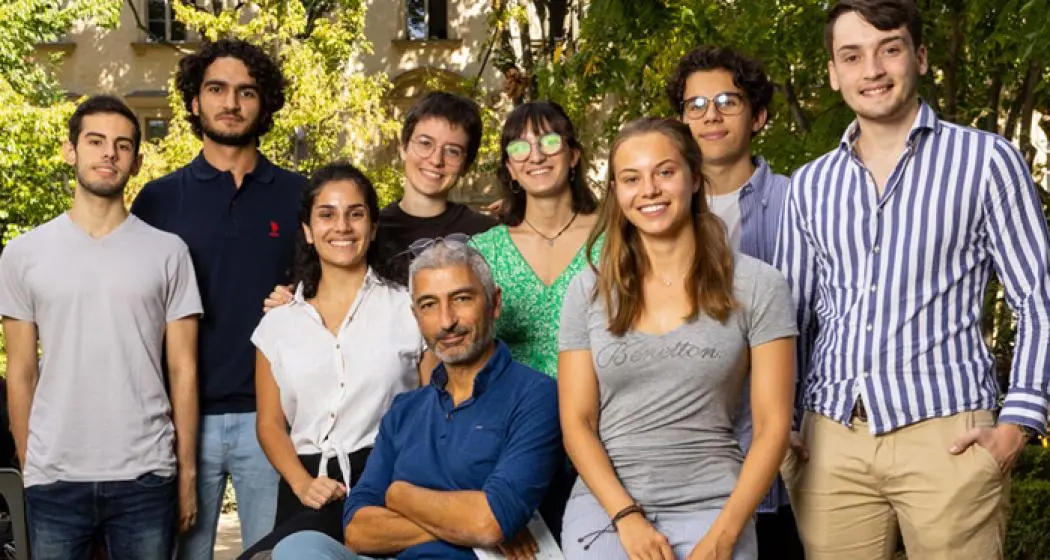
If you’re under 26, doing brilliantly at a university outside France, and curious enough to want a research-heavy education in Paris, the ENS Paris International Selection 2027 is one of the best deals in French higher education. Winners enter the École normale supérieure - PSL in the 3rd year of a bachelor’s (L3) or the 1st year of a master’s (M1). They get a grant and a room on an ENS campus, and they leave with a master’s and the ENS diploma. The window closes on 15 December 2026 at 14:00 Paris time, and it opened on 16 October, so you’re already ten days in.
Quick facts
| Detail | What ENS says |
|---|---|
| Type | Competitive entrance selection with grant and housing, not a standard scholarship application |
| Host | École normale supérieure - PSL, Paris |
| Entry level | 3rd year of bachelor (L3) or 1st year of master (M1) |
| Who can apply | Students from any country with foreign university studies, under 26 at opening |
| Application window | 16 Oct 2026, 14:00 to 15 Dec 2026, 14:00 (Paris time) |
| Platform | OnePSL30 (no email applications) |
| Support | €1,000 grant for 3 years plus a campus room |
| Results | Arts & Humanities from 9 March 2027; Sciences from 26 March 2027 |
Who is eligible
The age and residence rules are strict, so check them first.
Age. You must be under 26 on the day applications opened. For Arts & Humanities that means you hadn’t turned 26 on 16 October 2026.
Studies. In Sciences you need at least one year of undergraduate study at a foreign university, and at least two years by the time you enrol. In Arts & Humanities you must prove at least three years of study toward a foreign degree with full transcripts, but ENS says you may apply during your 3rd year.
Time in France. Sciences candidates can’t have been registered in a French school or higher education institution for more than 6 months in total across the competition year and the year before. Arts & Humanities allows no more than 10 months of residence in France in those two academic years.
One attempt. Sciences says you must not have applied to the International Selection before. The Arts & Humanities page has a garbled line (“must not have previously applied to the SI”), so assume the same rule and ask ENS.
No exemption from French in the humanities. ENS recommends fluency in French for Arts & Humanities. The motivation letter and research project are written in French (English is allowed for Economics, Linguistics and Cognitive studies), and the written exam is in French. Sciences is more forgiving: the cover letter can be in French or English, and you can answer the oral interviews in either.
The page doesn’t state a GPA minimum or a language certificate requirement. What it does say is “outstanding results”, and the transcript is a core part of the file.
What it covers
ENS says admitted students get a €1,000 grant for three years and a room on one of its campuses, then graduate with a master’s in their speciality and the ENS diploma. The page also says the grant is paid monthly between the 5th and 10th, with the first payment in October covering September and October. Because it doesn’t say “per month” explicitly, confirm whether €1,000 is monthly or total before telling readers.
Tuition, health insurance, visa costs and travel aren’t covered in the text I could read. The page does mention French social security and liability insurance as things you’ll set up, so budget for them, and ask ENS what tuition applies to you.
How to apply, step by step
- Choose your track (this week). Arts & Humanities offers disciplines like anthropology, history, philosophy, economics, literature and political studies. Sciences covers biology, chemistry, earth science, computer science, mathematics, physics and cognitive sciences. You pick one discipline.
- Create your OnePSL30 account. Don’t use an @icloud.com address, for you or your referees.
- Ask your referees now (2-4 weeks). You need 2 to 4 letters, requested through the platform by entering their email addresses. ENS warns that waiting until the last days is risky.
- Prepare your documents. Everyone submits a CV, university transcript, high school diploma and recommendation letters. Sciences adds an argued cover letter (1-3 pages, Times New Roman 12, 1.5 spacing). Arts & Humanities adds a motivation letter of the same format (in French) and a research project of up to 3 pages (10,000 characters) with a bibliography of 10 works.
- Write the research project carefully (Humanities, 2-4 weeks). ENS says it isn’t a cover letter. Pick a defined topic, state a core question, develop arguments and a few hypotheses, describe your material (fieldwork, archives, corpus) and cite real literature.
- Submit before 15 December 2026, 14:00 Paris time. Incomplete files aren’t considered. Convert that time to your own zone.
- Check the shortlist. Arts & Humanities from 21 January 2027; Sciences from 27 January. Everyone gets an email either way.
- Sit the remote tests. Arts & Humanities: 15 to 26 February (one written test in French, two orals). Sciences: 3 to 19 March (a scientific oral, then an interview).
- Get results and handle the visa. Admission results come from 9 March (Humanities) or 26 March (Sciences). Admitted students apply for a long-stay student visa and prepare certified, translated diplomas and a birth certificate for September registration.
Competitive reality check, and who should skip it
ENS publishes no acceptance rate or number of places on this page, so I can’t give one. Treat it as very selective: it’s a two-stage competition, with a file review and then remote exams, and the weights show where the points are. In Sciences, the scientific oral counts 6 and the interview counts 3. In Humanities, the written exam counts 1, the discipline oral 2 and the interview 2.
People tend to fail on the file rather than the talent. A generic cover letter, a research project that reads like a personal statement, a missing letter, or a transcript that doesn’t show consistent excellence all hurt.
Skip it if you’re 26 or older (unless ENS makes an exception, which it says happens rarely), if you’ve lived or studied in France more than the allowed months, if you’ve applied before, or if you’re aiming for a French-language humanities degree without working French. If you want a normal master’s with a scholarship rather than an entrance competition, other routes will suit you better.
FAQ
Can I apply while still in my 3rd year?
Yes. ENS says you may apply during your 3rd year of studies, though Sciences wants two years of study by enrolment.
Can I answer the interviews in English?
In Sciences, yes. In Humanities, the oral and interview are in French, though you may use English.
Is there a reading list to prepare?
No. ENS says there’s no specific reading programme, and it publishes past jury reports and subjects. Dictionaries and personal documents are banned in the exams.
Can I apply by email?
No. Only the OnePSL30 platform is accepted.
I won an Olympiad medal. Is there another route?
ENS lists a separate grants page for International Mathematical and Physics Olympiad medallists, so check that first.
Official link and what to check next
Read the full call on the official ENS international selection page and apply through OnePSL30. The ENS admissions team can be reached at concours.international@ens.psl.eu.
On MastersGrant, look next at other fully funded master’s scholarships in France, such as Eiffel Excellence, and at Erasmus Mundus joint master’s programmes. Both have different deadlines and don’t require a French competitive exam.
Ready to Apply?
Deadline is December 26, 2026 14:00. Don't miss it.
Apply on Official WebsiteNo application fee required through our portal.